

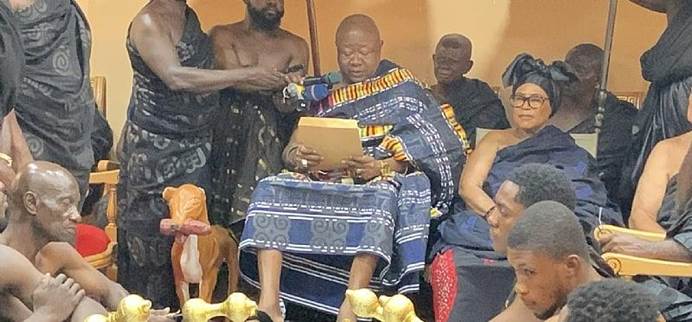
As of 2026, the current Paramount Chief of the Kumawu Traditional Area is Barima Sarfo Tweneboa Kodua. Recent Ghana News Agency reports from February and March 2026 identify him in that capacity.
1. His traditional position
Barima Sarfo Tweneboa Kodua is the Kumawumanhene, or Paramount Chief of the Kumawu Traditional Area in the Ashanti Region of Ghana. He is also identified as the head of the Kumawu Traditional Council. In February 2026, the Ghana News Agency reported him presiding over the launch of the 2026 Papa Nantwie Festival, while in March 2026 he was reported participating in the commissioning of a new community centre for Kumawu.
Thus, he is unquestionably a significant traditional authority within contemporary Asanteman.
It is important, however, to distinguish his position from that of the Asantehene. The Asantehene, Otumfuo Osei Tutu II, is the paramount traditional ruler of Asanteman and occupant of the Golden Stool. Barima Sarfo Tweneboa Kodua is the Paramount Chief of Kumawu, one of the historic traditional states within the Asante political system.

2. His traditional name: Tweneboa Kodua
The name Tweneboa Kodua is exceptionally important. It does not simply identify the present chief. It connects him symbolically with one of the most celebrated heroic figures in Asante history, Nana Tweneboa Kodua I of Kumawu.
Nana Tweneboa Kodua I of Kumawu.
According to Kumawu and Asante oral tradition, Tweneboa Kodua I played a decisive role in the Asante struggle against the Denkyira kingdom during the period associated with the formation of the Asante state. He is remembered for offering his life for the victory of Asanteman.
Consequently, the stool name Tweneboa Kodua carries a very heavy historical and symbolic responsibility. The modern Kumawu chief is therefore not merely carrying the name of an ancestor; he is occupying a stool whose identity is inseparably associated with bravery, sacrifice and loyalty to Kumawuman and Asanteman.
3. The historical Tweneboa Kodua
To understand the present chief, it is essential to understand the man whose name he bears. Traditional accounts state that during the Asante-Denkyira conflict, Komfo Anokye indicated that there was the need for a sacrifice with one of the mighty chiefs in order for the Asantes to obtain victory. All the chifs were quite for a short period of time, apparently each considering the idea of offering himself, and the consequence of death.
But to safe the situatuation, Tweneboa Kodua bravely stepped out to the middle of the gatthering of Chiefs, and voluntrarily offered himself to be used for the sacrifice of Asanteman. Quite relieved, all the chiefs happily applauded and hailed him as a great hero. Okomfo Anokye also congratulated him for his bravery and patriotism. Okomfo Anoky went further to make one request before he was sacrificed.
Out of selflessness but the love for his townsfolk, he did not ask of any material wealth which could have been used by his family, after his departure. There were abundance of gold and other minerals but he made one remarkable request which was hailed by all including Nana Otumfo Osei Tutu I and Okomfo anokye.
The request was that, he was making the sacrifice for the whole Asanteman, yet there should be a special considertion for the people of Kumawu when there was the need to send servants to accompany any dead chief to serve him at the land of the dead =Asamando. The people of Kumawu were to be excluded from being killed with the sword wherever they were. Nana Osei Tutu I, Okomfo Anokye and all the chiefs were happy with the request and therefore pledged to ensure his request to the letter. They therefore devised a means of differentiating the people of Kumawu with three short paralles lines on the two cheeks. With such marks, it was thus a taboo for any executioner or any Asante to use the sword on anyone from Kumawu.
He thus became the bravest personaity in the history of the Asantes to the honour of the people of Kumawu. The story is preserved in Ghanaian educational materials and local historical accounts as an example of:
- Ourage;
- Patriotism;
- Selflessness;
- Loyalty;
- Sacrifice; and,
- Service to One’s People.
The Kumawu District’s own historical account also associates the town’s identity with Tweneboa Kodua’s bravery.
A scholarly caution
The details of the sacrifice belong primarily to Asante oral tradition and historical memory. They should therefore be identified as traditional history rather than presented as independently verified modern historical fact.
4. Why the name “Barima” is significant
The title Barima itself carries a signifant meaning in the culture of the Asantes. In the Kumawu tradition, it is closely associated with the heroic legacy of Tweneboa Kodua. A historical account of the 2014 installation of the then Kumawu chief explains that the title Barima was associated with successors of Tweneboa Kodua because of the ancestor’s bravery and sacrifice for Asanteman.
Thus Barima Sarfo Tweneboa Kodua is not an ordinary personal name. It is a traditional identity connecting the occupant of the stool with the historic Kodua lineage and its heroic tradition.
5. His installation and the Kumawu succession dispute
This is an important part of his biography because his accession occurred during a complicated period in Kumawu chieftaincy history.
In October 2014, Dr. Emmanuel Yaw Kantanka Sarfo-Asante, a physician, was selected and installed as Kumawu chief under the stool name Barima Sarfo Tweneboa Kodua. Contemporary reports identified him as the 24th chief of Kumawu.
His installation was subsequently challenged.
In January 2015, another faction installed John Kwasi Oduro, a telecommunications technician, under the name Barima Tweneboa Kodua V, creating a rival-claim situation.
This dispute generated considerable tension.
It is important not to confuse historical discussion of that dispute with the present situation: contemporary 2026 reporting identifies Barima Sarfo Tweneboa Kodua as the Paramount Chief of Kumawu.
6. His Medical And Professional Background
One of the interesting facts recorded about the man installed in 2014 is that he was Dr. Yaw Sarfo-Asante, a physician. The contemporary report on his installation explicitly describes him as a physician. This gives his biography an interesting combination:
Modern Professional And Medical Training As Well As Traditional Royal Leadership.
That combination is increasingly characteristic of contemporary Ghanaian chieftaincy, where traditional leaders may simultaneously possess professional backgrounds in medicine, law, engineering, accountancy, education, business and other fields.
I would, however, avoid attaching additional medical qualifications or institutions to him unless they can be verified from an authoritative biography.
7. His Leadership Philosophy
At the beginning of his tenure, Barima Sarfo Tweneboa Kodua emphasized peace, unity and development.
In January 2015, he told the people of Kumawu that: “Kumawu could progress only if there was oneness of purpose and harmonious relations among the people.” This statement is particularly significant given the chieftaincy tensions surrounding his installation. His leadership philosophy can therefore be understood around three major concepts:
Peace
Resolving internal disagreements.
Unity
Bringing the different sections of Kumawuman together.
Development
Using traditional authority to promote the welfare of the people.
8. His role in Kumawu development
His contemporary activities show that his responsibilities extend beyond ceremonial functions.
In March 2026, he participated in the inauguration of a newly constructed community centre for the chiefs and people of Kumawu.
The Ghana News Agency reported that he described the facility as an important development for the traditional area and called for stakeholders to maintain it properly.
This illustrates his role as a development-oriented traditional leader.
The modern Kumawuhene therefore participates in matters involving:
- Community Infrastructure;
- Local Development;
- Traditional Administration;
- Cooperation With The District Assembly;
- Community Engagement; And
- Social Welfare.
9. His role in the Papa Nantwie Festival
One of the clearest recent examples of his cultural leadership was the 2026 Papa Nantwie Festival. The Kumawu Traditional Council launched the festival in February 2026 under the theme: “Bravery, Unity, and Identity: The Enduring Spirit of Our Ancestors.”
That theme is extraordinarily appropriate for Kumawu because its traditional identity is strongly associated with the courage of Tweneboa Kodua.
The festival seeks to:
- Honour Ancestral Bravery;
- Reconnect Young People With Their Heritage;
- Strengthen Unity Among Kumawu People;
- Promote Peace;
- Encourage Development; and
- Strengthen Cultural Identity.
Barima Sarfo Tweneboa Kodua therefore functions as a custodian of Kumawu historical memory.
10. His relationship with Asanteman
Kumawu occupies a very important position in Asante history.
Historical accounts identify Kumawu as one of the two prominent states that were competing for the capital position. Kumawu was before then known as anyaase and the other town which won the capital was Kwaman which became known as Kumasi. The Asante political union, including Kumawu, which had accepted the Golden Stool as the symbol of Asante unity under Osei Tutu I also accepted the position given to Kwanan as the seat of government for the ruler of the Asante Kingdom.
The political union of the asantes could consequently, accept four major new chages which were;
- Kumawu Traditional Area,
- Asanteman Traditional System,
- Asantehene and,
- The Golden Stool,
The Kumawuhene retains his own traditional authority while participating in the wider Asante traditional structure. This is why the Kumawuhene can be extremely important within Asante history without being the Asantehene himself.
11. The three royal gates of Kumawu
Another fascinating part of Kumawu history concerns its royal succession. Historical reporting has described three major royal gates:
- Ananaya
- Odumasi
- Ankase
These groups have historically disputed aspects of succession to the Kodua Stool. A 2015 account reported that the Asanteman Council under Otumfuo Osei Tutu II recognized the three royal gates as descendants of Tweneboa Kodua and Taa Akeampong.
This is important because it demonstrates that Kumawu royal genealogy is not a simple father-to-son succession system. As with other Akan traditional institutions, matrilineal descent and royal-family eligibility play important roles.
12. The Kumawu Stool and the Golden Stool
The Kumawu Stool should not be confused with the Golden Stool.
The Golden Stool is Supreme symbol of Asanteman
whereas:
Kodua Stool is the Royal Stool of only Kumawu and the naval towns and villages.
The Kumawu stool nevertheless has enormous historical significance because Kumawu is one of the traditional states that formed part of the Asante political union.
The present Barima Sarfo Tweneboa Kodua therefore carries the responsibility of protecting the Kodua Stool and Kumawu identity while participating in the larger Asante traditional institution.
13. His current role as of 2026
As of the latest reliable reports I found, Barima Sarfo Tweneboa Kodua remains the Paramount Chief of Kumawu.
In February 2026, he was publicly speaking as Kumawu’s paramount chief at the launch of the Papa Nantwie Festival.
In March 2026, he was again identified in Ghana News Agency reporting as the paramount chief during the commissioning of the community centre.
So there is no reason, based on the latest evidence, to treat him as a former Kumawuhene.
14. A concise biographical profile
| Category | Information |
| Name | Barima Sarfo Tweneboa Kodua |
| Traditional position | Paramount Chief of Kumawu Traditional Area |
| Traditional title | Kumawumanhene / Kumawuhene |
| Traditional state | Kumawu |
| Region | Ashanti Region, Ghana |
| Traditional system | Asanteman |
| Stool | Kodua Stool |
| Installation period | 2014 |
| Earlier professional identity | Dr. Yaw Sarfo-Asante; physician |
| Historical namesake | Nana Tweneboa Kodua I |
| Major traditional themes | Bravery, sacrifice, unity, peace and development |
| Current status | Paramount Chief as of 2026 |
The installation information and professional background are documented in contemporary accounts, while the current status is confirmed by 2026 Ghana News Agency reports.
15. The deeper historical significance
Dr. Tiger, I think there is something particularly important here for the line of research you began with your question about Israel → Africa → Akan → Asante.
The story of Kumawu gives us another very important branch of the Asante historical tree.
We can presently establish this chain at the level of traditional history:
Tweneboa Kodua I
↓
Kodua Stool of Kumawu
↓
successive Kumawu chiefs
↓
Barima Sarfo Tweneboa Kodua
↓
present Kumawu Traditional Area
And at the wider political level:
Kumawu
↓
Asante Union
↓
Golden Stool
↓
Asantehene
↓
Asanteman
The historical tradition concerning Tweneboa Kodua is particularly valuable because it predates the modern Republic of Ghana and connects Kumawu directly with the formative period of the Asante state.
One important correction to keep in mind
In my previous answer I referred to Otumfuo Osei Tutu II as the “current king of the Asante Kingdom.” That is appropriate in the sense of Asantehene, but for Kumawu it is more precise to say Paramount Chief of Kumawu Traditional Area. Ghana’s modern constitutional system does not recognize the Asante Kingdom as a sovereign state in the international-law sense; these are traditional institutions within the Republic of Ghana.
The most interesting next step
Since you are investigating the ancestral origins of Asanteman, I believe we should now go one step deeper.
I can prepare for you a detailed historical biography of Nana Tweneboa Kodua I, including:
(1) his ancestry,
(2) the origin of Kumawu,
(3) his relationship with Okomfo Anokye,
(4) his relationship with Osei Tutu I,
(5) the Asante–Denkyira War,
(6) the famous sacrifice of Tweneboa Kodua,
(7) why Kumawu became one of the most important Asante states,
(8) the complete succession of the Kumawu Kodua Stool, and, most importantly,
(9) whether there is any credible evidence connecting the Tweneboa Kodua/Kumawu lineage with the alleged Israelite migration to West Africa.
That last part could be especially useful for your historical and theological research because we can separate Bible evidence, Kumawu oral tradition, Asante royal tradition, archaeology, linguistics, and modern historical scholarship rather than mixing them together.
窗体顶端
窗体底端
Certainly, Dr. Tiger. This is a very worthwhile investigation, and I suggest we do it carefully and honestly, because there is a difference between what the Bible actually says, what Kumawu oral tradition says, and what later researchers have proposed.
I have examined the available evidence from those different categories. The most important conclusion at this stage is:
The Bible provides evidence for Israel’s movements, dispersions and presence in Africa, but it does not explicitly say that Israelites migrated to Kumawu, Asante, or Ghana.
Kumawu oral tradition provides a substantial indigenous account of Kumawu’s origins and the heroic history of Tweneboa Kodua, but it does not, in the sources I found, explicitly identify Kumawu as an Israelite settlement.
The proposed Israel–Akan/Asante connection therefore remains a hypothesis that must be tested against linguistic, archaeological, genealogical and oral evidence.
That does not mean the question should be dismissed. It means we should investigate it properly.
I. THE BIBLICAL EVIDENCE
1. Israel was a people with a history of migration
The Bible unquestionably presents Israel as a people who moved between regions.
The clearest example is the migration of Jacob and his descendants into Egypt:
“And Joseph was in Egypt already. And all the souls that came out of the loins of Jacob were seventy souls…”
— Exodus 1:5, KJV
The Israelites subsequently became a large population in Egypt.
Then God commanded Moses to bring them out of Egypt.
“I am the LORD thy God… and I will bring you out from under the burdens of the Egyptians…”
— Exodus 6:6, KJV
This establishes an important biblical principle:
Israelite identity was not confined permanently to one geographical location.
But this alone does not prove a later migration to West Africa.
II. THE BIBLE’S EVIDENCE FOR ISRAEL’S DISPERSION
This is much more important for the question you are investigating.
The Old Testament contains numerous passages describing Israel being scattered among the nations.
For example:
“And the LORD shall scatter thee among all people, from the one end of the earth even unto the other…”
— Deuteronomy 28:64, KJV
This is potentially relevant to a study of Israelite diaspora traditions.
But there is a critical distinction:
“Israel will be scattered among the nations” is biblical evidence for dispersion.
It is not automatically evidence that the Asante are those scattered Israelites.
We need another evidentiary bridge.
III. THE BIBLE AND AFRICA
The Bible certainly knows Africa.
Several African regions and peoples appear repeatedly in Scripture.
Egypt
Egypt is central to Israel’s early history.
Cush
Cush is repeatedly mentioned.
Ethiopia
The KJV frequently translates Cush as “Ethiopia.”
Libya/Put
Put is also associated with Africa in biblical geography.
Thus, Africa was not outside the biblical world.
But we must avoid an important mistake:
Biblical “Africa” does not automatically mean modern Ghana.
The geographical identification of ancient Cush, Put and other places must be established independently.
IV. A VERY IMPORTANT BIBLICAL PASSAGE: AMOS 9:7
This verse deserves serious attention:
“Are ye not as children of the Ethiopians unto me, O children of Israel? saith the LORD. Have not I brought up Israel out of the land of Egypt? and the Philistines from Caphtor, and the Syrians from Kir?”
— Amos 9:7, KJV
This is fascinating.
God places Israel, the Ethiopians/Cushites, the Philistines and the Syrians within a broader history of peoples being moved from one place to another.
But Amos 9:7 does not say that the Israelites became Ethiopians.
It actually distinguishes:
Israel ≠ Ethiopians/Cushites.
Therefore, this verse is evidence that the biblical writers knew of movements of peoples, including African peoples, but it cannot by itself establish an Israelite origin for the Akan.
V. ISAIAH 11:11 — ANOTHER IMPORTANT TEXT
Isaiah says:
“And it shall come to pass in that day, that the Lord shall set his hand again the second time to recover the remnant of his people…”
The passage continues by naming places from which Israelites would be gathered, including:
- Assyria
- Egypt
- Pathros
- Cush
- Elam
- Shinar
- Hamath
- the islands of the sea.
This is significant because Cush appears among places associated with the dispersion and restoration of Israel.
But again, Cush is not automatically Ghana.
The correct research question is therefore:
Could a historical Israelite population have moved progressively through North/East Africa and eventually reached West Africa?
That is a historical question—not something Isaiah 11 alone answers.
VI. THE “RIVERS OF CUSH” QUESTION
Another verse sometimes used in theories of Israelite migration is:
“From beyond the rivers of Ethiopia my suppliants, even the daughter of my dispersed, shall bring mine offering.”
— Zephaniah 3:10, KJV
This is interesting because the KJV says “beyond the rivers of Ethiopia.”
However, biblical scholars generally debate precisely which geographical region “Cush” refers to in different passages.
Therefore, we should not jump from:
Cush → Ethiopia → West Africa → Ghana → Asante.
Each geographical step requires evidence.
VII. THE ETHIOPIAN EUNUCH — ACTS 8
The New Testament gives us another important African connection.
Acts 8 describes an Ethiopian official who had travelled to Jerusalem and was returning home.
Philip encountered him reading Isaiah.
The man then accepted the message concerning Jesus and was baptized.
This establishes something historically significant:
By the first century, there was already an African individual sufficiently connected with Jewish Scripture and Jerusalem to be travelling there and reading Isaiah.
But again:
Ethiopian does not mean Asante.
The passage establishes early African participation in the biblical world, not an Asante-Israelite genealogy.
VIII. THE BIBLE THEREFORE GIVES US A “FRAME,” NOT A COMPLETE GENEALOGY
This distinction is extremely important.
The biblical evidence establishes:
Israel existed → Israel lived in Egypt → Israel was dispersed → Israelites lived among many nations → Africa contained peoples known to biblical writers → Israelites could be found outside their original homeland.
What the Bible does not provide is:
Israel → Egypt → Sudan → West Africa → Ghana → Akan → Kumawu.
No biblical passage gives that complete route.
Therefore, if such a migration occurred, the evidence must come from history, archaeology, oral tradition, linguistics, genetics and genealogy, rather than Scripture alone.
IX. NOW LET US TURN TO KUMAWU ORAL TRADITION
This is where the investigation becomes particularly interesting.
The official Ghana Districts historical account of Kumawu records an oral tradition connecting the town’s name with Okomfo Anokye.
According to the tradition, Anokye planted a kuma tree while seeking a suitable location associated with the Asante kingdom. The tree at the location died, producing the explanation:
Kuma + wu → Kumawu
or essentially “the kuma tree has died.”
This is an indigenous Kumawu explanation of the origin of the town’s name.
Notice something important:
The tradition does not say Israel.
It gives us an internal Asante/Kumawu explanation.
That is evidence we should preserve rather than replace with an external theory.
X. TWENEBOA KODUA I
The second major Kumawu tradition concerns Nana Tweneboa Kodua I.
The Kumawu historical tradition remembers him as a paramount chief whose actions were crucial to the Asante struggle against Denkyira.
The tradition states that he sacrificed himself so that Asanteman could obtain victory.
This is the central heroic tradition of Kumawu.
His name subsequently became so important that modern Kumawu chiefs have continued to carry the stool name Tweneboa Kodua.
The name also became associated with Kumawu’s traditional identity.
XI. THE TWENEBOA KODUA TRADITION AND THE ASANTE FOUNDING PERIOD
Here we encounter something historically important.
The Kumawu account connects Tweneboa Kodua with Osei Tutu I and the formation of Asanteman.
It therefore places Kumawu directly within the formative history of the Asante state.
However, I want to correct one detail in the earlier source we discussed.
The Ghana Districts page describes the Denkyira conflict as occurring in the 16th century, but Osei Tutu I’s reign and the conventional chronology of the Asante state belong principally to the late seventeenth and early eighteenth centuries.
Therefore, we should not repeat the “16th century” date as established fact without qualification.
This is precisely why your proposed investigation needs to compare oral traditions with chronological evidence.
XII. THE THREE LEVELS OF EVIDENCE
I recommend that we now organize the investigation into three categories.
A. WHAT IS DOCUMENTED
Examples:
- Kumawu exists as an important traditional state.
- Kumawu is part of Asanteman.
- The Kumawu stool is associated with the Tweneboa Kodua lineage.
- Tweneboa Kodua is remembered as a major Asante hero.
- Kumawu traditions associate him with the Asante-Denkyira conflict.
- Modern Kumawu tradition connects the town with Okomfo Anokye.
- The present Kumawu stool bears the name Tweneboa Kodua.
These are strong historical/traditional data points.
XIII. B. WHAT IS PROPOSED
There is a much older scholarly tradition proposing that the Ashanti/Akan have connections with ancient Hebrews.
One of the most important works is Joseph J. Williams’s Hebrewisms of West Africa, first published in 1930.
Williams devoted substantial portions of the book specifically to:
“Ashanti Hebrewisms,”
and later chapters to:
“The Lost Tribes of Israel,” “The Diaspora,” and the proposed movement of peoples from the Nile toward West Africa.
This means that your question is not a new invention.
There has been a published intellectual tradition attempting to investigate precisely this possibility.
But Williams’s work should be treated as a historical hypothesis and comparative study, not as conclusive proof.
XIV. WHAT WOULD COUNT AS STRONGER EVIDENCE?
This is where I believe your research can become much more rigorous.
We should look for convergence.
Suppose we found:
1. Oral tradition
A Kumawu tradition explicitly says:
“Our ancestors came from a particular northern/eastern land.”
2. Linguistics
A systematic linguistic comparison demonstrated an ancient Hebrew/Akan relationship that could not plausibly be explained by recent contact.
3. Archaeology
Material remains showed a migration from the relevant region into the Akan homeland during the appropriate period.
4. Genealogy
A continuous royal genealogy connected the relevant ancestral group with later Kumawu rulers.
5. Genetics
Population-genetic evidence independently supported substantial ancient ancestry from the proposed source population.
6. Biblical chronology
The proposed migration could be reconciled with the biblical chronology.
If all six independently pointed in the same direction, the case would become considerably stronger.
That is the standard I recommend.
XV. WHAT ABOUT LANGUAGE?
This is one of the areas where we must be extremely careful.
Akan/Twi belongs to the Kwa branch of the Niger-Congo language family.
Modern linguistic scholarship does not classify Akan as a Semitic language.
Therefore, simply finding words that resemble Hebrew words is insufficient.
For example:
similar sound ≠ common origin.
A proper linguistic demonstration would require examining:
- systematic sound correspondences;
- grammatical structures;
- core vocabulary;
- pronouns;
- numerals;
- kinship terminology;
- verb morphology;
- historical phonology;
- loanwords;
- reconstructed proto-forms.
Only then could we determine whether similarities are inherited, borrowed, or coincidental.
Modern scholarship treats Akan as a Niger-Congo/Kwa language, which is an important piece of evidence against a simplistic “Akan = Hebrew language” argument.
XVI. ARCHAEOLOGY
Archaeology is equally important.
Research into the origins of Akan populations has identified multiple demographic phases in the settlement of the southern Ghanaian forest, including prehistoric and early historic periods. Norman Klein’s research, for example, discusses archaeological and biological evidence concerning the population history of the southern Ghanaian forest.
This is important because it means that the history of Akan settlement should not automatically be reduced to a single migration from one distant location.
There may have been:
local population development + migrations + interaction + political consolidation + cultural borrowing.
That model is much more consistent with how population histories normally work.
XVII. A VERY IMPORTANT DISTINCTION: AKAN OR ASANTE?
We should also avoid treating these as exactly the same thing.
Akan is a broad ethnolinguistic grouping.
Asante is a particular historical and political formation within the Akan world.
Therefore:
Akan ancestry ≠ automatically Asante royal ancestry.
And:
Asante ancestry ≠ automatically Kumawu ancestry.
And:
Kumawu ancestry ≠ automatically Tweneboa Kodua ancestry.
We need to trace the chain step by step.
XVIII. THE KUMAWU EVIDENCE WE CURRENTLY HAVE
At present, our evidence can be represented like this:
Kumawu
↓
Kumawu oral tradition
↓
Okomfo Anokye tradition
↓
Asante formation
↓
Osei Tutu I
↓
Tweneboa Kodua I
↓
Denkyira conflict
↓
Kumawu’s heroic identity
↓
successive Kodua Stool occupants
↓
present Kumawu traditional institution.
This is a meaningful historical chain.
But the chain:
Israel → Kumawu
has not yet been demonstrated.
XIX. WHERE THE ISRAEL CONNECTION COULD BE INVESTIGATED
I would divide the investigation into seven evidence tests:
| Test | Question |
| Bible | Does Scripture permit the proposed historical movement? |
| Oral tradition | Do Kumawu/Asante traditions remember an eastern/northern origin? |
| Genealogy | Can the royal line be traced backward continuously? |
| Linguistics | Are there genuine historical Hebrew–Akan relationships? |
| Archaeology | Is there material evidence of the proposed migration? |
| Genetics | Is there population evidence supporting the proposed ancestry? |
| Comparative culture | Are similarities sufficiently distinctive to indicate historical transmission? |
The conclusion should then be based on all seven, rather than one or two similarities.
XX. WHAT I THINK IS THE MOST IMPORTANT FINDING SO FAR
Dr. Tiger, after separating the evidence, I would formulate our present conclusion this way:
Biblical evidence
Supports the possibility of Israelite dispersion into many regions, including Africa, but does not identify the Akan or Kumawu as Israelites.
Kumawu oral tradition
Strongly preserves the history of Kumawu, Okomfo Anokye, Tweneboa Kodua and the formation of Asante, but the sources examined so far do not explicitly say that Kumawu originated in Israel.
Asante history
Provides a well-developed indigenous historical tradition concerning the formation of Asanteman and the Golden Stool.
Israelite-origin theory
Has a documented history of scholarly advocacy, including Joseph J. Williams’s 1930 work, but remains unproven by mainstream historical scholarship.
Archaeology and linguistics
Currently provide stronger support for Akan development within West African/Niger-Congo contexts than for a straightforward ancient Israelite migration.
XXI. BUT WE SHOULD NOT STOP HERE
There is a much deeper investigation available.
The next stage should be to examine the actual Kumawu royal genealogy, beginning with:
Tweneboa Kodua I → subsequent Kumawu rulers → the three royal gates → the modern Kodua Stool → Barima Sarfo Tweneboa Kodua.
Then we can compare that genealogy with the Asante royal genealogy from Osei Tutu I backward.
After that, we can investigate the alleged northern/eastern migration traditions of the Akan, including Adanse, Bono, ancient gold-trading networks, Mande/Wangara connections and the various “Middle Eastern/Israelite” theories.
Finally, we can construct a Bible–Kumawu–Asante–Archaeology–Linguistics evidence matrix, marking every piece of evidence as:
🟢 Strong evidence
🟡 Possible/indirect evidence
🟠 Traditional claim requiring verification
🔴 Unsupported or contradictory evidence
That would give you something much more valuable than simply saying “the Asante came from Israel.” It would allow us to determine exactly what can and cannot presently be demonstrated.
And, importantly for your research, we can use the KJV for the biblical passages, while keeping the historical and scientific evidence separate from theological interpretation.
You are most welcome, Dr. Tiger. I have looked into this more carefully because the complete Kumawu succession is considerably more complicated than the list of Asantehene, and some published accounts conflict over particular royal lines and names.
The most important point is that there is no single modern online source that gives an uncontested, fully verified list of every Kumawu Omanhene from the earliest period to today. The principal historical source repeatedly cited for the genealogy is R. S. Rattray’s The Law and Constitution of Ashanti (1929), which contains a “Genealogy of Chiefs and Queen Mothers of Kumawu”. However, later Kumawu royal factions have disputed parts of that genealogy.
So I would rather give you a carefully qualified list than present disputed names as unquestionable fact.
Complete Kumawu Kings/Omanhene — the historically recoverable succession
I. The founding ruler
1. Nana Tweneboa Kodua I
Traditional period: formation of Kumawu’s paramount stool
Nana Tweneboa Kodua I is regarded in Kumawu tradition as the founder/originator of the Kodua Stool and the great ancestral ruler of Kumawu.
He is the famous Kumawu warrior associated with the Asante–Denkyira War during the reign of Osei Tutu I. Kumawu tradition holds that he sacrificed himself so that Asanteman could defeat Denkyira. His story remains central to Kumawu identity and the annual Papa Nantwie Festival.
He is therefore the essential starting point for the Kodua Stool genealogy.
II. Early Kodua-Stool succession
The historical material becomes much less certain after Tweneboa Kodua I.
A particularly important traditional genealogy identifies Seni Fonton and Adoforowa Hyie as ancestors associated with the royal lineage of Tweneboa Kodua. The descendants of Akosua Hema (also called Dwumo) are described in Rattray-related material as the Ananangya branch of the royal house, while another branch is associated with Etai Akyempong.
However, these genealogical claims have been fiercely disputed by different Kumawu royal factions. Therefore, I do not want to manufacture a continuous sequence of names for this early period.
III. A historically identifiable later ruler
2. Barima Yaw Dabo
Traditional account: 19th century
Yaw Dabo appears in the disputed Kumawu historical literature as an important occupant/regent associated with the Kodua Stool.
His accession is particularly controversial.
One Kumawu historical account says that he was connected to Ayoo and that he came to the stool during the period of Asantehene Osei Yaw Akoto, in connection with the escape of the Juabenhene during the events remembered as the Akwantu Kɛse.
Because this account comes from one side of a long-running Kumawu succession dispute, I would classify Yaw Dabo’s exact status in the succession as traditional/disputed evidence, rather than established fact.
IV. Barima Koduah Kokoo
3. Barima Koduah Kokoo
Barima Koduah Kokoo is another significant name in the Kumawu succession tradition.
A detailed Kumawu account identifies him as coming from the Ananangya branch and as Kumawuhene during the period associated with Asantehene Osei Yaw Akoto.
His reign is particularly important because the tradition connects him with the famous episode involving the escape of the Juabenhene through Kumawu.
Again, because the surviving accounts are strongly connected with the later Kumawu chieftaincy controversy, his precise chronological position should be checked against the original archival genealogy.
V. Barima Akwatra Feni
4. Barima Akwatra Feni
18th century
Akwatra Feni is one of the better-attested historical Kumawu rulers.
Rattray-related accounts state that Barima Akwatra Feni was destooled after displaying cowardice during the Banda war.
His name is particularly important because later disputes concerning eligibility for the Kumawu Stool refer to his descendants.
There is disagreement, however, concerning the interpretation of his destoolment and the subsequent customary restriction on his lineage.
VI. Barima Kwame Afram
5. Barima Kwame Afram
c. early 20th century
Barima Kwame Afram was a Kumawuhene during the colonial period and is especially important historically because he provided material concerning Kumawu genealogy to anthropologist R. S. Rattray.
Rattray’s The Law and Constitution of Ashanti (1929) contains the genealogical material associated with Kumawu, including the famous Figure 50, “Genealogy of Chiefs and Queenmothers of Kumawu.”
However, this genealogy is itself disputed.
Some Kumawu historians argue that the family tree supplied to Rattray was inaccurate or manipulated; others have treated Rattray’s documentation as important evidence.
Therefore:
Rattray’s genealogy is an important historical source, but it should not automatically be treated as an undisputed royal register.
VII. Barima Kwabena Kodua
6. Barima Kwabena Kodua
c. 1941–1951
This is one of the better-documented modern Kumawu rulers.
Court-related historical material states that Barima Kwabena Kodua, associated with the Ananangya royal house, was enstooled around 1941 and ruled for approximately ten years before abdicating/destooling in 1951.
His reign is extremely important because it demonstrates that the Kumawu Stool has historically involved more than one royal branch.
VIII. Barima Otuo Acheampong I
7. Barima Otuo Acheampong I
1951–1973
Barima Otuo Acheampong succeeded Barima Kwabena Kodua.
Historical accounts identify him as a major twentieth-century Kumawu ruler. He died on 3 March 1973, reportedly from a heart attack.
His reign was particularly important for Kumawu’s modern development.
For example, the Kumawu Traditional Council donated more than 400 acres of land for the establishment of Tweneboa Kodua Secondary School during his leadership. The school’s history identifies him as the Kumawuhene who supported the project.
IX. Barima Asumadu Sakyi II
8. Barima Asumadu Sakyi II
1973–2007
Barima Asumadu Sakyi II succeeded Otuo Acheampong in 1973 and remained Kumawuhene for approximately 34 years.
He died on 11 June 2007 at the 37 Military Hospital in Accra. Contemporary reporting states that he had become ill after collapsing in May 2007.
His extraordinarily long reign makes him one of the most important modern occupants of the Kumawu Stool.
X. The 2007–2014 succession crisis
This period is essential if we want a genuinely complete history.
After the death of Asumadu Sakyi II, Kumawu entered a prolonged succession dispute.
The Asantehene, Otumfuo Osei Tutu II, eventually became involved in the process.
The dispute involved different royal families and competing interpretations of who was entitled to occupy the Kodua Stool. Contemporary legal and journalistic accounts refer particularly to the Ankaase and Ananangya royal houses.
This is why simply producing a neat list of names without explaining the succession dispute can be misleading.
XI. Barima Sarfo Tweneboa Kodua
9. Barima Sarfo Tweneboa Kodua
Installed 2014 – present
Barima Sarfo Tweneboa Kodua was installed in October 2014 following the selection of Dr. Emmanuel Yaw Kantanka Sarfo-Asante. Contemporary reporting identifies him as a physician before his installation.
He is the current Kumawuhene/Paramount Chief of Kumawu.
This remains the case in 2026. Ghana News Agency reported him in February 2026 as the Paramount Chief of the Kumawu Traditional Area, and again in March 2026 in connection with development activities in Kumawu.
The succession we can presently document with reasonable confidence
Putting the better-supported names together gives:
| No. | Kumawu ruler | Period/status |
| 1 | Nana Tweneboa Kodua I | Founder/originator of Kodua Stool; traditional early period |
| 2 | Barima Yaw Dabo | 19th-century traditional account; status/sequence disputed |
| 3 | Barima Koduah Kokoo | 19th-century traditional account |
| 4 | Barima Akwatra Feni | 18th-century ruler; later succession traditions refer to his lineage |
| 5 | Barima Kwame Afram | Colonial-era ruler; associated with Rattray’s 1929 genealogy |
| 6 | Barima Kwabena Kodua | c. 1941–1951 |
| 7 | Barima Otuo Acheampong I | 1951–1973 |
| 8 | Barima Asumadu Sakyi II | 1973–2007 |
| 9 | Barima Sarfo Tweneboa Kodua | 2014–present |
But I do not recommend calling this a definitive “complete list” yet. There are missing rulers and/or alternative placements in the early and colonial portions of the succession.
An important discovery for our research
There is actually a much better primary-source route available.
R. S. Rattray’s The Law and Constitution of Ashanti contains the historical “Genealogy of Chiefs and Queen Mothers of Kumawu” on page 235 (Figure 50). Multiple later Kumawu discussions specifically cite that figure.
That is exactly the document we need if your objective is to establish the complete succession rather than merely a list reconstructed from newspapers.
And there is an additional reason this matters to your earlier Israel–Kumawu investigation.
The genealogy contains names such as:
Seni Fonton → Adoforowa Hyie → Tweneboa Kodua → the royal branches of Kumawu
and the disputed traditions concerning Ananangya, Odumase and Ankaase.
Those ancestral names could become extremely important when we investigate the origin question.
My recommendation
Rather than stop at this incomplete reconstruction, I can next undertake a Kumawu Royal Genealogy investigation, going back as far as the available sources permit:
Tweneboa Kodua I → Seni Fonton → Adoforowa Hyie → earlier ancestors → every known Kumawu Omanhene → Queen Mothers → Ananangya/Odumase/Ankaase branches → present Barima Sarfo Tweneboa Kodua.
I would put each ruler’s name, approximate reign, royal gate, mother/ancestry where documented, source, and confidence level into one chronological table. That would be considerably more reliable for your research than simply copying one disputed online list.
Absolutely, Dr. Tiger. I have gone further and found an important primary historical source that materially improves the reconstruction: R. S. Rattray’s The Law and Constitution of Ashanti (1929), which contains Figure 50, “Genealogy of the Chiefs and Queen Mothers of Kumawu,” on p. 235. The surviving catalogue of Rattray’s papers also confirms that he kept a separate Kumawu genealogy manuscript.
However, there is a serious complication: Kumawu’s royal genealogy has been disputed by different royal branches, especially concerning the Ananangya, Odumase and Ankaase lines. Therefore, below I distinguish documented evidence from claims made by competing traditions.
THE KUMAWU ROYAL GENEALOGY
From Tweneboa Kodua I to the present Kumawuhene
A. The ancestral foundation
| Generation | Name | Significance | Confidence |
| 1 | Seni Fonton | Identified in Kumawu traditions as an important ancestor of the Kodua royal line | 🟡 Traditional |
| 2 | Adoforowa Hyie | Traditionally associated with the ancestry leading to Tweneboa Kodua | 🟡 Traditional |
| 3 | Nana Tweneboa Kodua I | Great warrior and foundational figure of the Kumawu Kodua Stool | 🟢 Strong traditional/historical evidence |
| 4 | Taa Akeampong | Traditionally associated with the Kodua royal ancestry | 🟡 Traditional |
The names Seni Fonton and Adoforowa Hyie occur in the Kumawu genealogy controversy, with one side asserting that the genuine Ananangya and Odumase royals descend from them.
The identification of Tweneboa Kodua I as a major Kumawu ruler is considerably better established. Historical accounts of the Asante-Denkyira War identify him as one of the principal Kumawu figures associated with the war. Rattray’s account, as summarized in later histories, says that Tweneboa Kodua was killed during the conflict, while Kumawu tradition preserves the story of his sacrifice.
B. The three principal Kumawu royal branches
This is one of the most important findings.
Modern accounts describe three competing or interconnected royal gates:
- Ananangya / Ananaya
- Odumase / Odumasi
- Ankaase / Ankase
A 2015 report on the Kumawu dispute described all three as claiming descent from Tweneboa Kodua and Taa Akeampong. It also noted that the Asanteman Council had declared members of all three gates to be descendants of those ancestors.
But another body of Kumawu historical writing strongly disputes that interpretation and says that Ananangya and Odumase descend from Seni Fonton, while Ankaase has a different origin through a woman called Ayoo.
Therefore, I would not yet write that all three genealogies are historically proven.
C. The Rattray genealogy
This is extremely important.
Rattray’s 1929 book contains:
“Genealogy of the Chiefs and Queen Mothers of Kumawu”
as Figure 50, p. 235.
Rattray’s accompanying note, reproduced in later discussions, says:
- descendants of Akosua Hema (Dwumo) were known as the Anenenya/Ananangya branch;
- descendants of Etai Akyeampong were known as the Abira or Apebiakyere line;
- in the time of Kobina Kodia, elders supposedly determined that chiefs should be selected from a particular line;
- Kwaku Boaten’s name did not appear on the genealogical table.
This tells us something very important:
The Kumawu royal genealogy was already complex in the nineteenth/early twentieth-century tradition.
It was not simply:
Tweneboa Kodua I → son → grandson → great-grandson.
It involved matrilineal branches, royal women, stool eligibility and customary restrictions.
D. The important rulers we can recover
Here is the most defensible reconstructed sequence, rather than pretending that every missing generation is known.
1. Nana Tweneboa Kodua I
Founder/hero of the Kodua Stool
He is the central ancestral figure of Kumawu.
He is traditionally remembered as one of the men whose sacrifice secured the Asante victory over Denkyira.
A modern history of Ghana records the tradition that three men—Tweneboa Kodua of Kumawu, Duku Pim of Ejisu and Bobie of Bonwere—were associated with the sacrificial traditions surrounding the war.
Status: 🟢 Strong traditional/historical evidence.
2. Kobina Kodia / Kobina Kodua
Rattray’s genealogical note specifically refers to the time of Kobina Kodia and to a decision by the elders concerning which royal line should supply chiefs.
The exact position of Kobina Kodia within the complete succession requires examination of the original Figure 50 rather than relying on later partisan reproductions.
Status: 🟡 Historically attested, exact genealogical position requires verification.
3. Kwaku Boaten
Rattray’s note explicitly says:
“Kwaku Boaten’s name naturally does not appear on the genealogical table.”
That is particularly interesting.
It suggests that Kwaku Boaten was remembered in Kumawu’s political history even though he was not included in the particular genealogical branch shown in the table.
Status: 🟡 Historically/traditionally attested.
4. Barima Akwatra Feni
Akwatra Feni is one of the most important later Kumawu chiefs.
Rattray’s material states that he was destooled after the Banda war, with the reason given as cowardice.
Later Kumawu accounts say that his descendants were subsequently prohibited from occupying the paramount stool.
This prohibition itself is part of the disputed customary history and should not be treated as an uncontested constitutional rule without checking the original records.
Status: 🟢 Chief historically documented; 🟡 details of the subsequent prohibition disputed.
E. Yaw Dabo — a crucial turning point
5. Yaw Dabo
This is where the genealogy becomes particularly controversial.
According to one major Kumawu tradition, Yaw Dabo was the son of Ayoo, and his sister Yaa Mansah became associated with Asantehene Osei Yaw Akoto.
During the period of the Akwantu Kese, when Juabenhene Kwasi Boateng fled through Kumawu, the then Kumawuhene is identified in this tradition as Koduah Kokoo.
The same tradition claims that Koduah Kokoo was subsequently killed and that Yaw Dabo was appointed regent to oversee his burial and maintain order.
This is the alleged point at which the Ankaase line entered the Kumawu stool succession.
But there is an enormous caution here:
The account that Yaw Dabo was the son of a former slave woman named Ayoo and that his accession was illegitimate is found principally in polemical writings produced during the modern Kumawu chieftaincy dispute.
It should therefore be recorded as:
A major Kumawu oral/traditional claim—not yet established historical fact.
That distinction is crucial.
F. Koduah Kokoo
6. Barima Koduah Kokoo
Koduah Kokoo is particularly important because the Kumawu tradition places him immediately before the Yaw Dabo episode.
The tradition says he belonged to the Ananangya branch and was Kumawuhene during the reign of Asantehene Osei Yaw Akoto.
He is said to have been killed following the dispute surrounding the fleeing Juabenhene.
Again, this requires comparison with independent archival evidence before we can establish precisely what happened.
Status: 🟡 Strongly preserved in Kumawu traditional accounts.
G. Barima Kwame Afram
7. Barima Kwame Afram
This is one of the most historically important Kumawu chiefs for our investigation.
Why?
Because R. S. Rattray obtained the Kumawu genealogy during the period of Kwame Afram’s chieftaincy.
Rattray’s book contains a photograph identified as:
“Kwame Affram, Kumawu Hene”
and another of Ya Amponsa, mother of Kwame Affram and Queen Mother of Kumawu.
Thus, Kwame Afram was not merely a name in a later oral account.
He was an actual Kumawu chief whose historical period overlaps with Rattray’s research.
This makes his testimony extremely important—but also explains why later factions have disputed the genealogy he supplied.
One side argues that the genealogy he supplied to Rattray was inaccurate or politically motivated.
That allegation is not something we should simply accept as fact; it is itself a claim made during the chieftaincy dispute.
H. Barima Tweneboa Kodua IV
8. Barima Tweneboa Kodua IV — Nana Seth
This is a particularly important discovery.
Manhyia Archives records an official historical case:
“Akwamuhene vs. Kwasi Kodia IV, Kumawuhene” — 1948–1951.
This independently confirms that Kodia/Kodua IV was Kumawuhene during this period.
Other Kumawu accounts identify him as:
Barima Tweneboa Kodua IV, popularly known as Nana Seth,
and place his reign approximately 1940–1950.
The slight difference in dates illustrates precisely why we should use archival records rather than rely solely on later articles.
Status: 🟢 Strong archival confirmation.
I. Barima Kwabena Kodua
9. Barima Kwabena Kodua
The modern historical/legal record identifies Barima Kwabena Kodua as a Kumawu chief around 1941–1951. However, because this overlaps with accounts of Tweneboa Kodua IV, the naming and chronology require special care.
This may reflect:
- alternative names;
- different royal lines;
- overlapping/intervening reigns;
- or later reconstruction of the genealogy.
I therefore would not place Kwabena Kodua and Tweneboa Kodua IV in a simple consecutive sequence without consulting the original stool records.
This is an excellent example of why a “complete list” cannot safely be assembled merely by combining internet lists.
J. Barima Otuo Acheampong I
10. Barima Otuo Acheampong I
1951–1973
This is one of the clearest modern reigns.
He succeeded the earlier twentieth-century occupants and ruled until his death in 1973.
His reign is particularly significant for education and development in Kumawu.
The establishment of Tweneboa Kodua Secondary School is associated with Kumawu’s traditional leadership and land provision. Contemporary school history identifies the traditional authority involved in this development.
Status: 🟢 Strong modern historical evidence.
K. Barima Asumadu Sakyi II
11. Barima Asumadu Sakyi II
1973–2007
He succeeded Otuo Acheampong I and remained on the stool for approximately 34 years.
He died in June 2007.
His long reign makes him one of the most important modern Kumawu rulers.
Status: 🟢 Strong modern historical evidence.
L. Barima Sarfo Tweneboa Kodua
12. Barima Sarfo Tweneboa Kodua
2014–present
He was installed in October 2014.
The man installed under the stool name was Dr Emmanuel Yaw Kantanka Sarfo-Asante, a physician.
He remains the current Kumawuhene. Ghana News Agency reports from February and March 2026 continue to identify him as Paramount Chief of Kumawu.
A CRITICAL GAP: 2007–2014
After Asumadu Sakyi II died in 2007, Kumawu experienced a prolonged succession dispute.
This period cannot simply be treated as an ordinary gap between kings.
Different factions advanced competing candidates, and the dispute eventually reached the Asanteman Council and the courts.
In 2014, another claimant, John Kwasi Oduro, was installed under the name Barima Tweneboa Kodua V, creating a rival claim to the stool.
Therefore, for historical accuracy:
The 2014 succession should be recorded as:
Barima Sarfo Tweneboa Kodua — recognized/current Kumawuhene
with a rival installation by Barima Tweneboa Kodua V during the dispute.
We should not silently erase the rival claim from the historical record.
THE RECONSTRUCTED TIMELINE
Here is the version I would currently use in serious research:
| # | Ruler / figure | Approximate period | Evidence |
| 1 | Seni Fonton | Early ancestral period | 🟡 Oral genealogy |
| 2 | Adoforowa Hyie | Early ancestral period | 🟡 Oral genealogy |
| 3 | Tweneboa Kodua I | Asante founding period | 🟢 Strong traditional history |
| 4 | Kobina Kodia | Later traditional period | 🟡 Rattray tradition |
| 5 | Kwaku Boaten | Traditional period | 🟡 Rattray note |
| 6 | Akwatra Feni | 18th century | 🟢 Rattray/historical |
| 7 | Koduah Kokoo | Early 19th century | 🟡 Kumawu tradition |
| 8 | Yaw Dabo | 19th century | 🟡 Disputed tradition |
| 9 | Kwame Afram | Colonial period | 🟢 Rattray documentation |
| 10 | Tweneboa Kodua IV / Kodia IV | c. 1940s–1951 | 🟢 Manhyia archival evidence |
| 11 | Kwabena Kodua | c. 1940s–1950s | 🟡 Chronology requires reconciliation |
| 12 | Otuo Acheampong I | 1951–1973 | 🟢 Strong modern record |
| 13 | Asumadu Sakyi II | 1973–2007 | 🟢 Strong modern record |
| — | Succession dispute | 2007–2014 | 🟢 Documented |
| 14 | Sarfo Tweneboa Kodua | 2014–present | 🟢 Current official/public record |
This is not yet the final “complete list.”
And I want to emphasize that because you asked specifically for complete.
The evidence I found demonstrates that the missing early rulers cannot responsibly be filled by guessing. The original Rattray genealogy is the key document we need to reconstruct them.
A VERY IMPORTANT DISCOVERY FOR OUR ISRAEL–KUMAWU RESEARCH
There is something particularly valuable here.
The Royal Anthropological Institute’s catalogue of R. S. Rattray’s original papers records:
“Kumawu genealogy: the earth at Santemansu”
and also separately records genealogical manuscripts collected by Rattray.
This is potentially much more valuable than relying on websites.
It means that there may be original fieldwork material behind Rattray’s published genealogy.
That gives us a potentially powerful research path:
Original Kumawu oral genealogy
↓
Rattray’s field notes
↓
Rattray’s 1929 published genealogy
↓
later Kumawu oral traditions
↓
modern royal claims
↓
comparison with archaeology and linguistics
That is exactly the kind of evidence chain we need for your larger question about whether any genuine ancestral connection can be traced beyond the Akan/Asante world toward ancient Israel.
My assessment at this stage
I would assign the evidence as follows:
🟢 Established/strong: Tweneboa Kodua I as a major Kumawu ancestral ruler; the existence of the Kodua Stool; Kwame Afram; Kodia IV/Tweneboa Kodua IV; Otuo Acheampong I; Asumadu Sakyi II; and the current Sarfo Tweneboa Kodua.
🟡 Traditional but requiring corroboration: Seni Fonton, Adoforowa Hyie, the exact succession between Tweneboa Kodua I and the later chiefs, Kobina Kodia, Kwaku Boaten, and the precise role of Yaw Dabo.
🟠 Contested: The claim that Yaw Dabo descended from Ayoo and that this makes the Ankaase line non-royal.
🔴 Not established: Any connection between Seni Fonton/Tweneboa Kodua/Kumawu and ancient Israel.
That last point is particularly important. We should not use the Kumawu genealogy to prove an Israelite origin until we have independently established the geographical and ancestral link.
The next document I would examine
The single most valuable next step is to reconstruct Rattray’s Figure 50 exactly, including every name, spouse, mother, child, stool, branch and succession marker, and then compare it with the competing Ananangya, Odumase and Ankaase genealogies.
That will give us, for the first time in this investigation, a proper Kumawu Royal Genealogical Chart rather than a list assembled from modern articles.
