

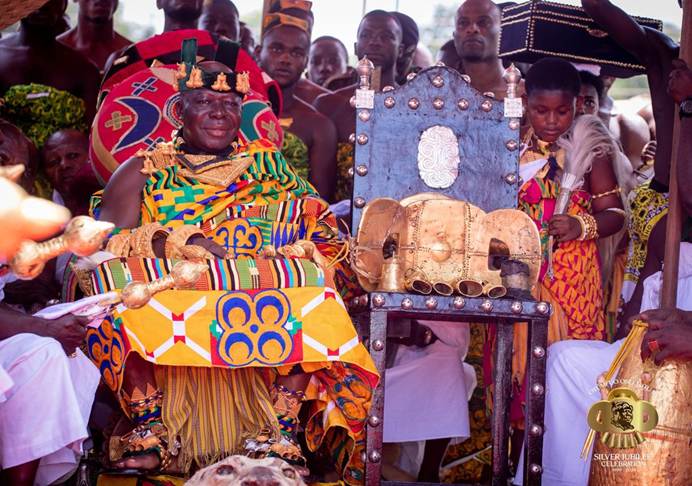
THE 16TH ASANTEHENE AND CUSTODIAN OF THE GOLDEN STOOL
Otumfuo Osei Tutu II, born Nana Barima Kwaku Dua on 6 May 1950, is the 16th Asantehene (King of Asante) and the current occupant of the Golden Stool. He was enstooled on 26 April 1999, succeeding his cousin, Otumfoɔ Opoku Ware II. The Manhyia Archives identifies him as a direct descendant of Otumfoɔ Osei Tutu I, the founder of the Asante Kingdom.
1. Birth and royal ancestry
Otumfoɔ Osei Tutu II was born on 6 May 1950 in Kumasi, then part of the Gold Coast, and was given the birth name Barima Kwaku Dua.
He is the youngest of the five children of Nana Afua Kobi Serwaa Ampem II, the Asantehemaa (Queen Mother of Asante). His upbringing was therefore situated directly within the Asante royal institution.
His royal lineage is particularly important because Asante succession operates through the matrilineal system. Consequently, the Queen Mother has an exceptionally important constitutional and customary role in identifying and supporting a candidate for the Golden Stool.
The Manhyia Archives specifically identifies Osei Tutu II as a direct descendant of Otumfoɔ Osei Tutu I. His father was Nana Kwame Boakye-Dankwa, who was associated with Kantinkyere and served as Brehyia Duke of Asante.
2. His childhood education in Asante traditions
One of the most significant aspects of his childhood was that his education was not merely academic.
From childhood, he was placed under the tutelage of his uncle, Oheneba Mensah Bonsu, who had been enstooled as Hiahene in 1952. According to the Manhyia Archives, his uncle deliberately ensured that the young royal was trained in Asante traditions and statecraft outside the Kingdom of Asante. Ironically, he received such training from a tender age at the Sehwi Kingdom where he had been sent by his uncle, Otumfoɔ Opoku Ware 11 who intentionally wanted external and hard experience for his nephew who was to succeed him.
He was not simply a highly educated Ghanaian who subsequently became king. He had been prepared from childhood for the possibility of traditional leadership.
3. His Secondary Education
His secondary education took him outside Kumasi. He attended Sefwi Wiawso Secondary School in Ghana’s Western Region. During this period, his guardian was Nana Kwadwo Aduhene II, the Omanhene (Paramount Chief) of the Sefwi Wiawso Traditional Area.
This experience gave the young royal exposure to another traditional political environment beyond Kumasi and the Asante capital.He subsequently returned to Kumasi in 1969, where he enrolled at Osei Kyeretwie Secondary School (OKESS).
4. His Higher Education
In 1971, Barima Kwaku Dua moved to Accra and entered the Institute of Professional Studies (IPS), Legon, to study Accountancy. He subsequently travelled to the United Kingdom, where he continued his accountancy studies at Kilburn Polytechnic.
He later attended the institution now associated with the University of North London/London Metropolitan University, studying areas including Human Resource Development and Public Administration.
Thus, his education combined:
- Traditional Asante Statecraft;
- Secondary Education;
- Accountancy;
- Human-Resource Development;
- Public Administration; And
- International Professional Experience.
That combination would later become significant in the way he approached traditional leadership.
5. His professional life before becoming Asantehene
An important part of OtumfoɔOsei Tutu II’s biography is that he had a professional career before becoming king. He did not move directly from royal upbringing into the Golden Stool. The Manhyia Archives records that he accumulated professional experience in Canada and Britain before returning permanently to Ghana.
Among the positions associated with his professional career were:
Canada
He worked as a Senior Consultant with Mutual of Omaha Insurance Company in Toronto.
United Kingdom
He worked in financial and administrative positions, including work associated with Oxo and the Manpower Services Commission attached to Brent Council.
These experiences exposed him to:
- Corporate Management;
- Finance;
- Personnel Administration;
- Insurance;
- Public Administration;
- Organisational Management; And
- International Business.
This was quite different from the traditional chiefly environment into which he had been born.
6. His Return to Ghana
In 1989, Barima Kwaku Dua returned to Ghana and established Transpomech International (Ghana) Ltd.
His decision to establish a business in Ghana is significant because it demonstrates that before becoming Asantehene he had already developed experience as a businessman and administrator.
He therefore entered traditional leadership after experiencing both Ghanaian society and international professional life.
7. The Death of Otumfoɔ Opoku Ware II
The succession that eventually brought him to the Golden Stool followed the death of Otumfoɔ Opoku Ware II in February 1999.
Opoku Ware II had been the 15th occupant of the Golden Stool, reigning from 1970 to 1999. Following his death, the process of selecting the next Asantehene began within the customary structures of Asanteman. Barima Kwaku Dua was selected as the successor.
His nomination reportedly received broad acceptance within Asanteman and Ghana. The Manhyia Archives describes the selection as being received with “universal acclaim” and emphasizes his calmness, tact and capacity for reconciliation.
8. Enstoolment As Otumfoɔ Osei Tutu II
On 26 April 1999, Barima Kwaku Dua became Otumfoɔ Osei Tutu II. He thereby became: The 16th Asantehene and the occupant of the Golden Stool. The Golden Stool is not merely a physical throne.
Within Asante political and spiritual tradition, it is the supreme symbol of the unity and authority of Asanteman. Consequently, becoming Asantehene means assuming responsibility for an institution that is considerably older than the modern Republic of Ghana.
9. His philosophy of traditional leadership
One of the most striking characteristics of Otumfuo Osei Tutu II’s reign has been his emphasis on Peace and Reconciliation.
According to the Manhyia Archives, one of his earliest major objectives was to encourage people involved in land and succession disputes to pursue arbitration rather than prolonged litigation. This reflects an important conception of traditional authority: The King is not merely a Ruler; he is a Mediator and Custodian of Social Harmony.
The Manhyia Archives describes his leadership in terms of:
- Reconciliation;
- Healing Divisions;
- Arbitration;
- Motivation;
- Education;
- Health; and
- Economic Development.
10. His work in education
Education has been one of the central pillars of his reign.
He established the Otumfoɔ Education Fund, intended to mobilise resources for education at various levels, including:
- Primary Education;
- Secondary Education;
- Tertiary Education; and
- Vocational Education.
The Manhyia Archives reports that during its early years the fund supported more than 4,000 students.
The Otumfoɔ Osei Tutu II Foundation continues this broader educational mission today, identifying quality education as one of its principal areas of intervention.
11. His contribution to health
Health has been another major component of his development agenda.
His initiatives have included support for programmes addressing:
- Maternal Mortality;
- Infant Mortality;
- Eye Diseases;
- Glaucoma;
- Buruli Ulcer;
- Guinea Worm;
- Childhood Diseases; and
- Immunisation.
The Foundation today describes its mission as improving the quality of life of Ghanaians through Education, Health, Sustainable Infrastructure, Ict, Tourism And Socioeconomic Empowerment.
12. The Otumfoɔ Osei Tutu II Foundation
The Foundation has become one of the principal institutional vehicles through which his social-development vision is pursued. Its stated mission is to improve the quality of life of Ghanaians by increasing access to:
- Education 2. Health 3. Sustainable Infrastructure 4. Ict 5. Tourism 6. Socioeconomic Empowerment. Its work therefore extends beyond Asanteman.
The Foundation explicitly states that the Asantehene’s initiatives seek to create impact throughout Ghana, rather than limiting his social-development activities to the Ashanti region.
13. His work in economic development
Otumfoɔ Osei Tutu II has also promoted economic development. The Manhyia Archives records his vision of an Asanteman Economic Revitalisation Plan, involving areas such as:
- Private Investment;
- Local Industries;
- Reforestation;
- Irrigation;
- Land Access; and
- Community Development.
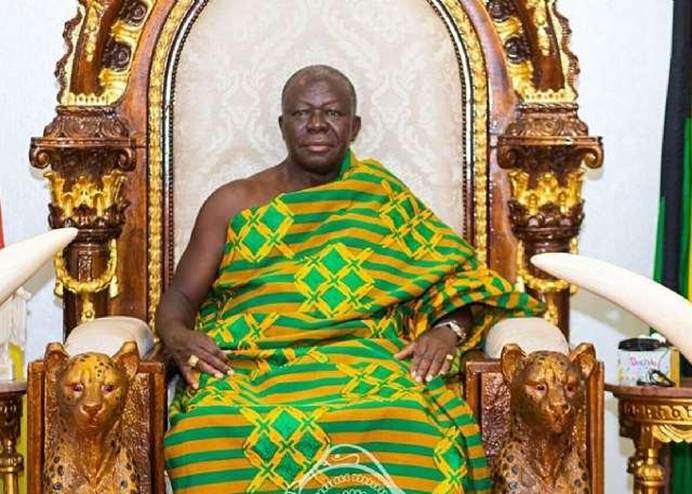
This represents an evolution in the role of traditional authority. Rather than treating the traditional institution solely as a custodian of history and culture, his approach has attempted to connect traditional leadership with economic and social development.
14. Traditional leadership and modern Ghana
Perhaps one of his most important historical contributions has been his attempt to reconcile traditional authority with modern democratic Ghana.
The Asantehene does not function as Ghana’s constitutional head of state as Ghana is a republic. Nevertheless, the Asantehene possesses enormous cultural, historical and traditional authority among the Asante and considerable influence nationally. Otumfoɔ Osei Tutu II has therefore operated at the intersection of:
Traditional Authority, Modern Governance, Education, Development, Culture, International Diplomacy. His reign represents an example of how a traditional institution can adapt to a modern nation-state.
15. His Role At KNUST
Otumfoɔ Osei Tutu II is the Chancellor of Kwame Nkrumah University of Science and Technology (KNUST) in Kumasi. KNUST’s official website currently identifies him as Chancellor and Asantehene. His role at KNUST is symbolically significant.
KNUST represents: science + technology + research + innovation + education,
while the Asantehene represents: tradition + culture + history + customary authority. His chancellorship therefore provides a striking institutional connection between Asante tradition and modern scientific education.
16. Honorary academic recognition
Otumfoɔ Osei Tutu II has received honorary doctoral degrees from several universities.
The Manhyia Archives records honorary degrees associated with institutions including:
- University of Glasgow;
- University of Maryland Eastern Shore;
- Essex County College;
- University of Ghana; and
- Kwame Nkrumah University of Science and Technology.
He also received the Symons Award from the Association of Commonwealth Universities in April 2000, according to the Manhyia Archives.
17. International diplomacy
His influence has not been confined to Ghana. During his reign he has interacted with numerous international leaders and institutions.
The Manhyia Archives records visits and engagements involving international figures and institutions, including the British royal establishment and other international leaders.
His international role has generally focused on:
- Ghanaian Culture;
- Asante Heritage;
- Peace;
- Education;
- Development;
- Investment;
- African Traditional Leadership; And
- Ghana’s Relationship With The International Community.
18. Preservation of Asante Culture
Another fundamental responsibility of the Asantehene is the preservation of Asante culture. Otumfoɔ Osei Tutu II has therefore functioned not only as a political/traditional leader but also as a custodian of Asante cultural identity.
His responsibilities encompass matters involving:
- Asante History;
- Royal Traditions;
- Customary Law;
- Traditional Festivals;
- Chieftaincy;
- Stool Institutions;
- Traditional Authority;
- Cultural Artefacts;
- Language;
- Music;
- Traditional Diplomacy; And
- The Golden Stool.
The Manhyia Archives itself was established to preserve and provide access to records concerning Asanteman and the Kumasi Traditional Council.
19. His relationship with the Golden Stool
The Golden Stool is arguably the most important institution in understanding his kingship. Otumfoɔ Osei Tutu II is the 16th occupant of the Golden Stool.
Thus, when we speak of “Otumfoɔ Osei Tutu II,” we are not merely referring to an individual person. We are referring simultaneously to:
- A man 2. A Royal lineage 3. The Asantehene Institution 4.The Golden Stool 5. Asanteman. This is why the position carries such extraordinary significance in Ghanaian history.
20. His leadership legacy
After more than two decades on the Golden Stool, his principal areas of emphasis can broadly be summarized as:
1. Peace
Promoting arbitration and reconciliation in disputes.
2. Education
Supporting students and educational institutions.
3. Health
Supporting health interventions for vulnerable populations.
4. Economic development
Encouraging investment and community development.
5. Cultural preservation
Protecting Asante history, traditions and heritage.
6. Traditional leadership
Modernising and strengthening the institution of chieftaincy.
7. National unity
Using traditional authority to promote peace beyond Asanteman.
8. International engagement
Presenting Asante and Ghanaian culture to the international community.
9. Higher education
Serving as Chancellor of KNUST.
10. Philanthropy
Supporting vulnerable communities through his Foundation.
21. His Significance In The History Of Asante
There is a remarkable historical continuity here. Otumfoɔ Osei Tutu I founded the Asante political union in the late seventeenth/early eighteenth century. More than three centuries later, Otumfoɔ Osei Tutu II occupies the same royal stool name.
The Manhyia Archives explicitly identifies the present king as a direct descendant of Otumfoɔ Osei Tutu I. This makes his reign especially interesting for historical research because it connects:
Otumfoɔ Osei Tutu I, The Formation Of Asanteman, The Golden Stool, Colonial Conflict, The Restoration Of Asante Authority, Modern Ghana, Otumfoɔ Osei Tutu Ii.
The Manhyia Archives is especially valuable for such work because it was established specifically to preserve records of Asante history and is managed by the Institute of African Studies, University of Ghana, on behalf of the Asanteman and Kumasi Traditional Councils.
Manhyia Archives — official royal history
KNUST — Chancellor: Otumfuo Osei Tutu II
Otumfuo Osei Tutu II Foundation
In Short: OTUMFOƆ OSEI TUTU II is not merely the current Traditional Ruler of the Asante People. He is the 16th Occupant Of The Golden Stool, A Direct Descendant of Otumfoɔ Osei Tutu I, A Product of Both Traditional Asante Education and International Professional Experience, A Major Advocate Of Education and Health, A Mediator In Traditional Disputes, A Cultural Custodian, Philanthropist, and Chancellor of KNUST.
